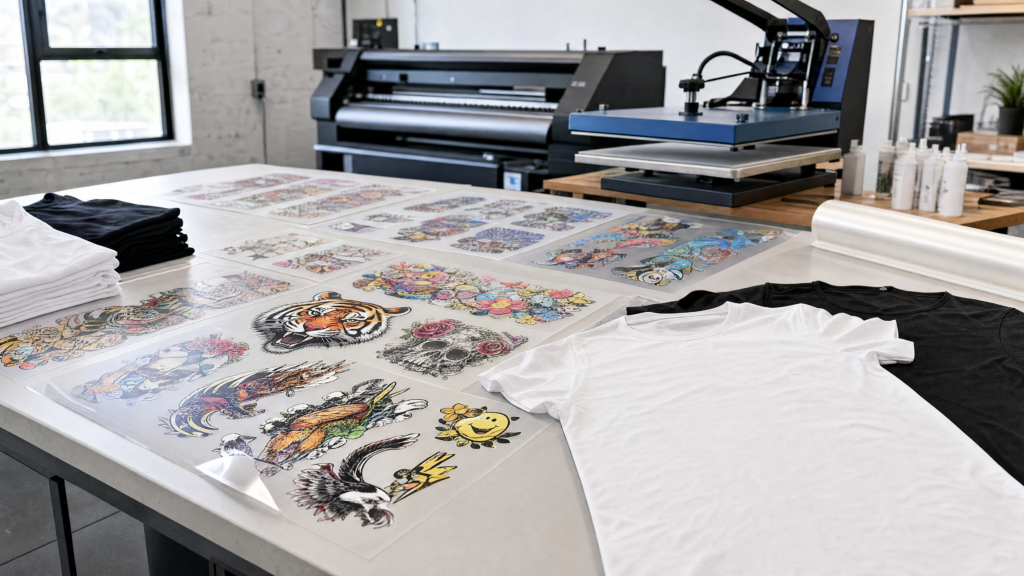
If you run a print shop, clothing brand, embroidery business, promotional company, or apparel resale operation, you may be asking whether it is time to buy a DTF printer or keep using wholesale DTF transfers.
The short answer is: not necessarily. For many businesses, outsourcing to a wholesale DTF transfer supplier is the more predictable choice. You avoid equipment costs, daily maintenance, consumables, production labor, and unused capacity while still getting ready-to-press transfers for your apparel orders.
Owning equipment can make sense at steady, high volume. But the right decision depends on your actual workload, available space, labor, deadlines, and total cost per garment, not just the price of a printer or the convenience of wholesale DTF transfer orders.
Wholesale DTF Transfers or Your Own Printer?
Wholesale DTF transfers are a practical alternative to owning a DTF printer because they let businesses order finished direct-to-film transfers without managing the complete printing process in-house.
With outsourcing, you submit artwork or build a gang sheet, place an order, receive the printed transfers, and apply them with a heat press. With in-house production, you manage the full process:
- DTF printer and RIP software
- CMYK and white ink
- PET film
- Adhesive powder
- Powder application and curing
- Printer cleaning and maintenance
- Quality checks and troubleshooting
- Production labor and workspace
- Storage for supplies and finished transfers
That difference is easy to underestimate. A DTF printer is not a complete apparel production solution by itself.
What In-House Wholesale DTF Printing Really Requires
Buying a printer may appear to lower your cost per transfer. However, the material cost is only one part of the calculation.
Equipment investment
An in-house setup may require a DTF printer, curing equipment, a heat press, ventilation or workspace adjustments, and supporting tools. The exact investment depends on the equipment size, automation, production volume, and workflow you choose.
The initial purchase is also not the only equipment cost. You may eventually need replacement parts, maintenance supplies, software updates, or additional equipment if demand increases.
Consumables
Regular production uses film, CMYK ink, white ink, adhesive powder, cleaning supplies, and packaging materials. These costs vary based on design coverage, waste, print settings, and how efficiently your operator manages the process. If you are comparing in-house output with wholesale DTF printing, those material inputs need to be counted carefully.
White ink also requires consistent handling and maintenance. If the printer sits idle, your team still needs a clear care routine to help prevent avoidable print problems.
Labor and learning curve
In-house DTF printing adds tasks that do not exist when you buy ready-to-press DTF transfers:
- Prepare and inspect artwork.
- Set up the print file.
- Load film and manage ink.
- Print the transfer.
- Apply adhesive powder.
- Cure the powder.
- Inspect the finished transfer.
- Clean and maintain equipment.
- Correct errors or reprint unusable work.
Someone has to perform these steps, whether that is the owner, an employee, or a dedicated production operator.
Space and idle capacity
A printer, curing station, film rolls, powder, ink, and finished transfers require organized space. The workflow also needs room for safe handling, staging, and quality checks.
If your demand is seasonal or inconsistent, the equipment may spend part of the year underused. That idle capacity still represents tied-up capital, floor space, and maintenance responsibility.
In-House Printing vs. Outsourcing
The better option is the one that supports your current workflow. Buying equipment because you may need it later can create more overhead than value, especially when wholesale DTF transfers already cover many short-run and repeat-order needs.
When Wholesale DTF Transfers Make More Sense
Outsourcing is often a strong fit when:
- DTF orders are occasional, seasonal, or still growing.
- You already specialize in screen printing, embroidery, or promotional products.
- You want to add wholesale DTF printing without adding a full production department.
- Your order mix includes many designs and quantities.
- You need predictable transfer pricing for customer quotes.
- You do not have a dedicated printer operator.
- You want to avoid printer downtime and maintenance.
- You would rather invest in sales, artwork, blanks, and fulfillment.
For example, a screen-printing shop may receive a customer request for 20 detailed full-color shirts. Buying and operating a DTF printer for that occasional job may not be practical. Ordering custom DTF transfers from a wholesale DTF transfer supplier allows the shop to accept the work while keeping the existing workflow focused.
A clothing brand may also prefer outsourcing during a design-testing stage. The brand can order transfers, press garments as orders come in, and avoid committing to a large quantity of finished shirts before demand is proven. That is one reason wholesale DTF transfer orders and DTF transfers no minimum are useful in early-stage apparel production.
Why Square-Foot Pricing Matters
Wholesale DTF transfers are commonly evaluated by the amount of printed sheet area used. That makes square-foot pricing more useful than comparing only the price of one isolated design, especially for bulk DTF transfers and mixed-layout jobs.
DTFZoo’s current published wholesale pricing starts at $2.00 per square foot, with higher-volume pricing reaching $1.25 per square foot. Pricing can depend on total square footage and the live order configuration, so verify current pricing before approving a quote or customer order.
A simple transfer-only estimate is:
Total transfer cost = total square feet × current price per square foot
For example, if a layout uses 40 square feet and the applicable published rate is $2.00 per square foot, the transfer portion would be approximately $80 before shipping or other applicable costs. This is an illustration, not a checkout quote.
The final cost per garment may also include:
- Blank apparel
- Transfer allocation
- Heat pressing labor
- Packaging
- Inbound shipping
- Payment or marketplace fees
- Spoilage or test garments
- Outbound fulfillment
Use DTFZoo’s DTF transfer cost-per-shirt guide to separate transfer cost from the full cost of a decorated garment. If you want a general reference on pricing models and productivity in apparel decoration, PRINTING United Alliance publishes apparel decoration industry resources that may also help frame your internal costing process.
DTF Gang Sheets Improve Transfer Efficiency
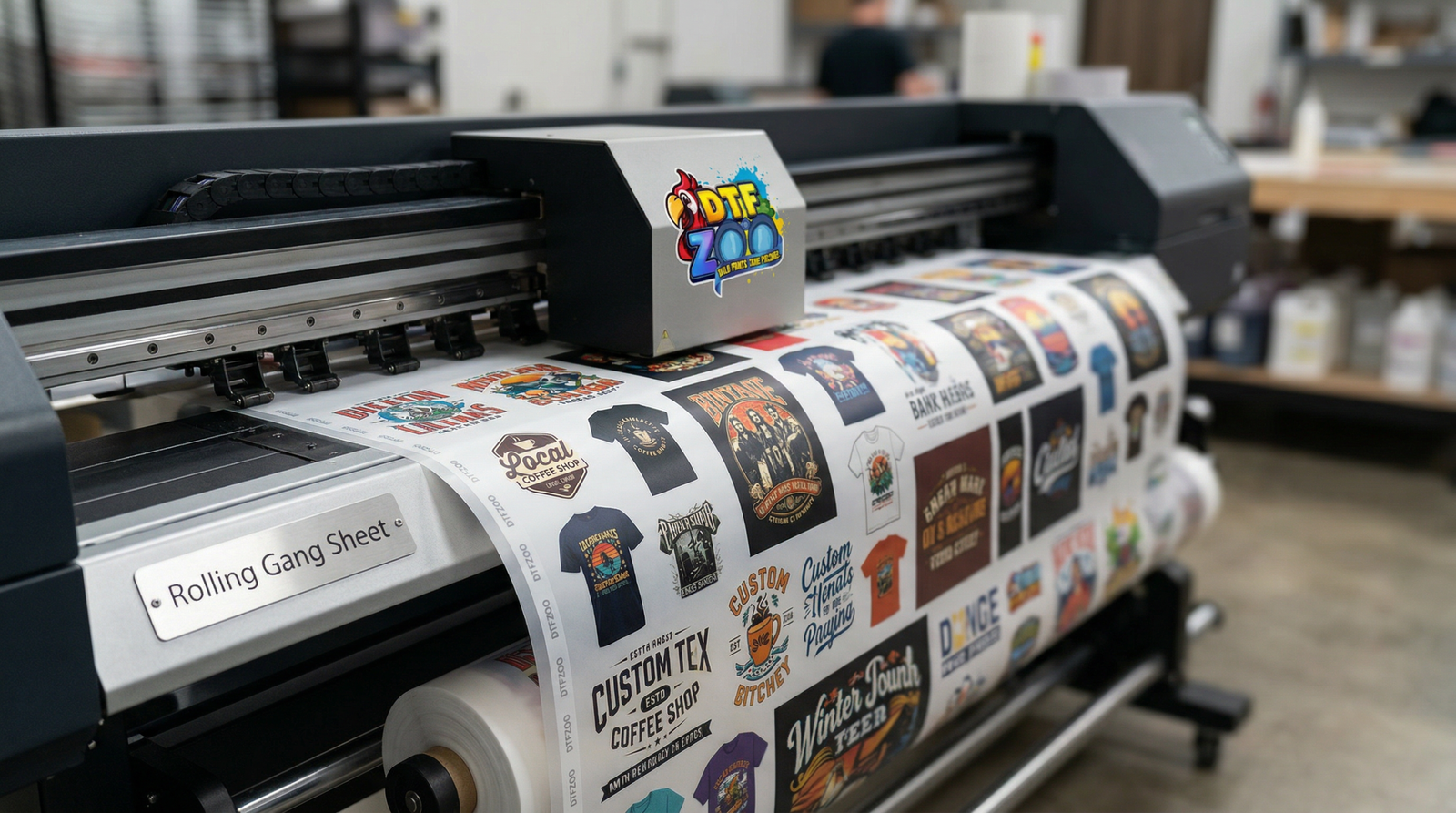
A DTF gang sheet combines multiple designs on one sheet. You can include full-front graphics, left-chest logos, sleeve prints, neck labels, and repeat artwork in one organized layout.
Gang sheets are especially useful for:
- Mixed customer orders
- Seasonal apparel drops
- Small-batch clothing brands
- Repeat logo packs
- Reseller inventory
- Sample runs
- Bulk DTF transfers with multiple designs
The goal is not to pack designs together so tightly that trimming becomes difficult. The goal is to use available space efficiently while leaving practical room between designs, which is especially important when planning wholesale DTF transfer orders across multiple placements.
DTFZoo offers two ordering paths:
- Use the Rolling Gang Sheet Builder to upload, size, and arrange designs online.
- Use Upload Your Gang Sheet if you already have a print-ready layout.
For artwork, review the DTF transfer artwork requirements before ordering. Clean, correctly sized files reduce avoidable production issues. For general heat application reference, many decorators also keep heat transfer instructions and press-setting guidance on hand when reviewing pressing workflows.
How to Calculate Your True Cost Per Garment
Use the same method whether you are comparing outsourcing with in-house printing or setting prices for customers.
Step 1: Calculate the outsourced transfer cost
Record:
- Total purchased square footage
- Current price per square foot
- Shipping or order-level costs
- Number of usable transfers
Do not calculate only from the visible artwork dimensions if you are purchasing a complete gang sheet. Spacing, cutting room, and unused layout area can affect the paid sheet area.
Step 2: Allocate the transfer to each garment
If every shirt receives one comparable transfer:
Transfer cost per garment = total transfer cost ÷ number of garments
If some garments receive front and back prints, calculate each placement separately.
Step 3: Add garment and production costs
Add the blank garment, pressing labor, packaging, and applicable fees. If an order includes multiple designs or garment types, calculate each group separately.
Step 4: Calculate the in-house alternative
For in-house production, include:
- Equipment depreciation or financing
- Film and ink
- Adhesive powder
- Maintenance supplies
- Operator labor
- Utilities
- Waste and failed prints
- Workspace costs
- Heat pressing and packaging
Step 5: Compare actual monthly demand
Look at your last several months of DTF work. Separate consistent demand from one-time projects. A printer may be justified by stable volume, but projected demand alone should not determine the purchase.
Step 6: Consider capacity and deadlines
Owning equipment gives you more direct control over production scheduling. Outsourcing wholesale DTF transfers gives you a simpler workflow, but production time and shipping time are separate.
DTFZoo currently states 1–2 business day production and ships nationwide across all 50 states. Production is the time used to make the transfers; carrier transit happens afterward. Plan the full delivery window rather than treating the production estimate as the arrival date. If you are setting up or reviewing an in-house production area, OSHA provides general workplace ventilation standards that may be useful when evaluating print and curing spaces.
Common Mistakes About Buying a DTF Printer
“The printer price is the total cost.”
It is not. The complete setup includes curing, film, ink, powder, labor, maintenance, workspace, and possible downtime.
“More volume always means buying equipment.”
Not automatically. You also need consistent demand, staff, space, and a workflow that can keep the equipment productive.
“The cheapest DTF transfers are always the best value.”
A low listed price may not reflect the full cost of artwork corrections, wasted garments, slow reorders, or production delays. Compare the usable transfer cost and the complete job cost, whether you are buying bulk DTF transfers or placing smaller custom DTF transfers orders.
“Gang sheets should be packed as tightly as possible.”
Efficiency matters, but designs still need enough spacing for trimming, sorting, and pressing. A slightly less crowded layout may be faster to handle.
“Production time equals delivery time.”
Production and shipping are different stages. Confirm both when planning launches, events, and customer deadlines.
When Should You Buy a DTF Printer?
An in-house setup may be worth evaluating when you have:
- Stable, recurring DTF volume
- A trained operator
- Dedicated production space
- A clear maintenance routine
- Enough demand to keep the equipment active
- Frequent deadlines that outsourcing cannot support
- A documented cost advantage after all overhead is included
Outsourcing is usually easier to justify when demand is variable, the business is testing DTF, or the team wants to add apparel printing without taking on another technical production process. For many operators, that means continuing with wholesale DTF transfers until the numbers clearly support equipment.

FAQ
What are wholesale DTF transfers?
Wholesale DTF transfers are ready-to-press direct-to-film transfers ordered for business apparel production. They can include custom designs, repeated logos, or multiple graphics arranged on DTF gang sheets. Businesses often use wholesale DTF transfers to simplify short runs, repeat jobs, and mixed-design orders.
Is outsourcing wholesale DTF printing cheaper than buying a printer?
It depends on volume and overhead. Outsourcing usually requires less upfront investment and makes costs easier to quote. In-house production may reduce the transfer-only cost at consistent volume, but equipment, labor, maintenance, consumables, and idle capacity must be included.
Are DTF transfers with no minimum useful for small businesses?
Yes. DTF transfers with no minimum allow businesses to test designs, handle small customer jobs, and scale gradually without committing to a large order. DTFZoo currently states that it has no minimum order requirement and no membership fee. That flexibility is one reason many buyers start with wholesale DTF transfers before evaluating equipment.
How do DTF gang sheets reduce costs?
Gang sheets can reduce wasted printable space by combining multiple designs on one layout. The savings depend on how efficiently the sheet is arranged and how much of the purchased area becomes usable production.
How fast are DTFZoo orders produced?
DTFZoo currently states a 1–2 business day production time. Shipping transit is separate and depends on the carrier and destination.
What should I check before ordering custom DTF transfers?
Confirm final artwork dimensions, transparent backgrounds, resolution, design quantities, sheet spacing, garment placement, and the current supplier requirements. A clean file and accurate layout make the order easier to review and press. For post-press garment handling, a practical outside reference is this guide to care for clothes with heat transfers.
Conclusion: Choose the Workflow That Protects Your Margin
You do not automatically need a DTF printer to offer professional apparel printing. For many print shops, clothing brands, resellers, and apparel businesses, wholesale DTF transfers provide a simpler way to manage demand without taking on equipment, maintenance, consumables, labor, and unused capacity.
Buying a printer may make sense once volume is consistent and the complete in-house cost is clearly lower. Until then, outsourcing can help you test designs, handle mixed orders, build DTF gang sheets, manage bulk DTF transfers, and keep production flexible with wholesale DTF transfers.
Ready to compare your options? Review DTFZoo’s current wholesale pricing, build a gang sheet, or upload a print-ready layout for your next wholesale DTF transfer order.